
' d='M0 0h21v15H0z'/%3E%3Cpath d='M0 0h21v1H0V0zm0 2h21v1H0V2zm0 2h21v1H0V4zm0 2h21v1H0V6zm0 2h21v1H0V8zm0 2h21v1H0v-1zm0 2h21v1H0v-1zm0 2h21v1H0v-1z' fill='url(%23b)'/%3E%3Cpath fill='url(%23c)' d='M0 0h9v7H0z'/%3E%3Cpath d='M1.5 2a.5.5 0 110-1 .5.5 0 010 1zm2 0a.5.5 0 110-1 .5.5 0 010 1zm2 0a.5.5 0 110-1 .5.5 0 010 1zm2 0a.5.5 0 110-1 .5.5 0 010 1zm-5 1a.5.5 0 110-1 .5.5 0 010 1zm2 0a.5.5 0 110-1 .5.5 0 010 1zm2 0a.5.5 0 110-1 .5.5 0 010 1zm1 1a.5.5 0 110-1 .5.5 0 010 1zm-2 0a.5.5 0 110-1 .5.5 0 010 1zm-2 0a.5.5 0 110-1 .5.5 0 010 1zm-2 0a.5.5 0 110-1 .5.5 0 010 1zm1 1a.5.5 0 110-1 .5.5 0 010 1zm2 0a.5.5 0 110-1 .5.5 0 010 1zm2 0a.5.5 0 110-1 .5.5 0 010 1zm1 1a.5.5 0 110-1 .5.5 0 010 1zm-2 0a.5.5 0 110-1 .5.5 0 010 1zm-2 0a.5.5 0 110-1 .5.5 0 010 1zm-2 0a.5.5 0 110-1 .5.5 0 010 1z' fill='url(%23a)'/%3E%3C/g%3E%3C/svg%3E)
' d='M0 0h21v15H0z'/%3E%3Cpath fill='url(%23b)' d='M10 0h11v15H10zM0 0h7v15H0z'/%3E%3Cpath fill='url(%23a)' d='M7 0h7v15H7z'/%3E%3Cpath d='M8 7a2.5 2.5 0 001.247 2.164.5.5 0 00.502-.865A1.499 1.499 0 019 7a.5.5 0 00-1 0zm3.846 2.107A2.498 2.498 0 0013 7a.5.5 0 10-1 0 1.5 1.5 0 01-.693 1.265.5.5 0 10.539.842z' fill='%23628A40' fill-rule='nonzero'/%3E%3Ccircle fill='%23DCC26D' cx='10.5' cy='7' r='1'/%3E%3C/g%3E%3C/svg%3E)
Orthodontics for Adults and Children
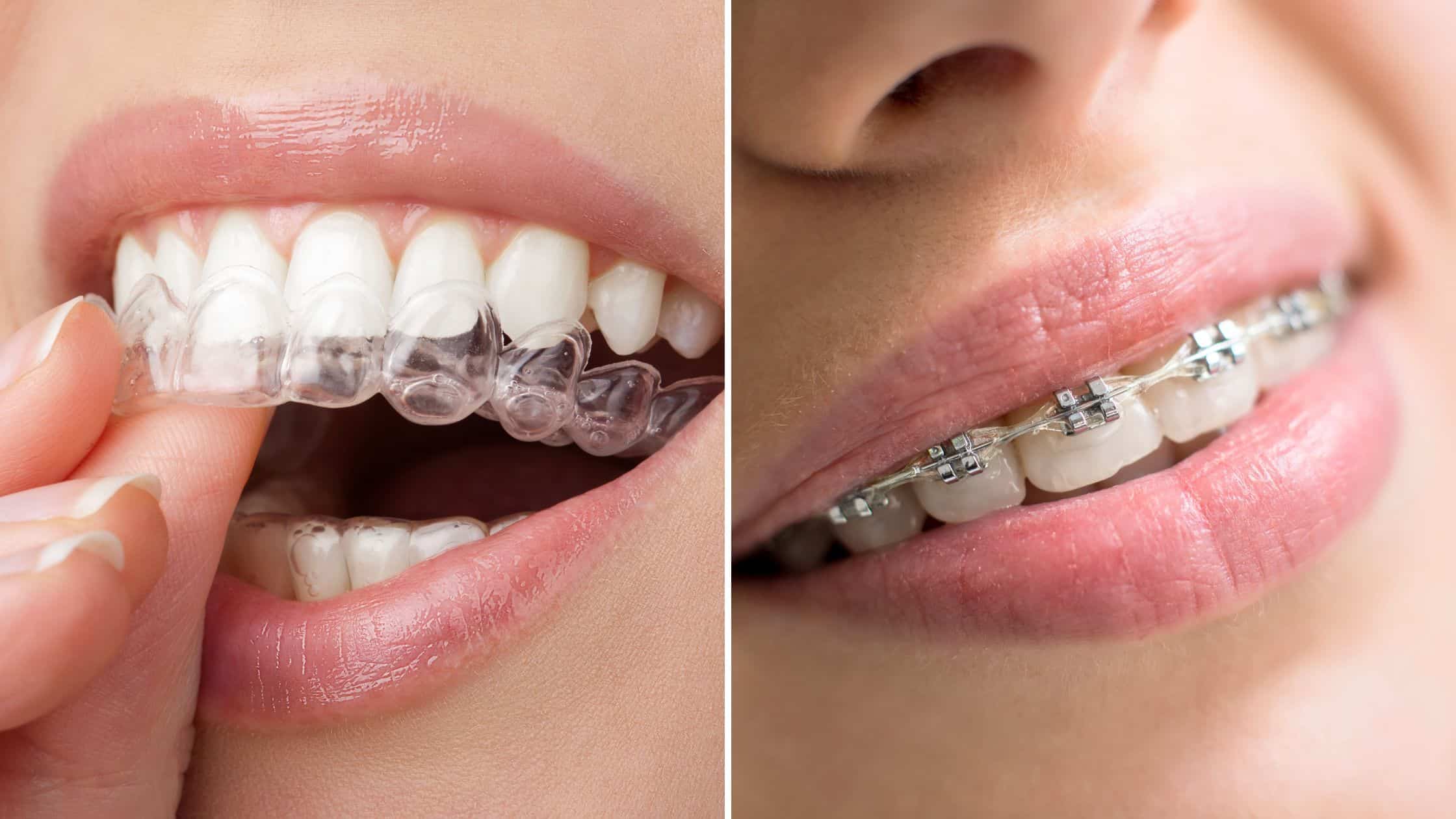
In Guatemala, the choice between traditional orthodontics and clear aligners is increasingly relevant. Orthodontics with braces uses fixed brackets to move teeth, making it ideal for severe cases. Invisible aligners are removable and discreet, perfect for adults seeking aesthetics.
Characteristics of Traditional Orthodontics and Clear Aligners
Traditional orthodontics utilizes fixed bracket techniques to gradually move teeth to their desired position. On the other hand, clear aligners work through customized removable trays that fit the patient’s teeth.
Techniques Used in Traditional Orthodontics
- Placement of brackets: metallic, ceramic, or sapphire on the teeth.
- Use of wires: to exert pressure and correct dental position.
- Periodic adjustments: by the orthodontist to advance the treatment.
To learn more details about the different materials, consult our guide on types of dental crowns that are used in complex cases requiring additional restoration.
How Clear Aligners Work
- Custom removable trays: which are changed progressively to promote tooth movement.
- Gentle and constant pressure: on the teeth to achieve alignment.
- Greater comfort and freedom: during treatment as they are removable.
Advantages and Disadvantages of Each Method
Traditional orthodontics offers greater precision in complex cases but can be less aesthetic. Clear aligners are discreet and favor better oral hygiene but may be less effective in certain severe dental problems that require root canal treatment or prior extractions.
Key Differences Between Traditional Orthodontics and Clear Aligners
When comparing traditional orthodontics with clear aligners in Guatemala, it is crucial to consider various variables that differentiate both treatments.
1. Aesthetics and Discretion
Traditional Orthodontics:
- Traditional brackets can be more visible, impacting oral aesthetics.
- Ceramic or sapphire brackets offer better aesthetics than metallic ones.
- Ideal for severe cases where efficacy outweighs aesthetic considerations.
Clear Aligners:
- They are virtually invisible, going unnoticed.
- A more aesthetic and discreet option, especially attractive to professional adults.
- They can be combined with dental veneers after treatment to optimize aesthetics.
2. Treatment Duration
Comparison of Timelines:
- Clear aligner treatments can have variable durations depending on complexity.
- Traditional orthodontics is usually more predictable in complex cases.
- Both methods require similar time in moderate cases.
3. Oral Hygiene During Treatment
Traditional Orthodontics:
- Can make oral hygiene difficult due to the presence of brackets.
- Requires special dental cleaning techniques.
- Requires special brushes and specific hygiene products.
Clear Aligners:
- Allow for better cleaning as they are completely removable.
- Patients can maintain their normal hygiene routine.
- Reduce the risk of cavities and periodontal disease during the treatment.
4. Effectiveness by Case Type
Ideal Cases for Traditional Orthodontics:
- Severe dental malpositions.
- Cases requiring complex rotations.
- Patients who need prior wisdom tooth extraction.
- Cases requiring coordination with other treatments such as dental crowns.
Ideal Cases for Clear Aligners:
- Mild to moderate malpositions.
- Adults seeking discretion.
- Patients with excellent discipline for constant use.
- Cases that benefit from a comprehensive smile design.
Special Considerations for Children and Adolescents
For orthodontics in children, it is important to consider that:
- Traditional brackets are usually more effective in mixed dentition.
- They require special care during treatment.
- In some cases, they may require laser frenectomy as a complementary treatment.
Costs and Economic Considerations
Price Comparison:
- Traditional orthodontics: Generally more economical, especially with metallic braces.
- Clear aligners: Higher investment but with significant aesthetic benefits.
To find updated prices, consult our specific guides: Prices for orthodontics with braces / Prices for invisible aligners.
Complementary Treatments
Regardless of the chosen method, some patients may benefit from:
- Teeth whitening post-treatment.
- Dental fillings for prior restorations.
- Comprehensive smile design to optimize results.
How to Choose the Best Option
The choice between traditional orthodontics and clear aligners should be based on:
- Severity of the clinical case.
- Patient’s age.
- Lifestyle and aesthetic preferences.
- Available budget.
- Discipline for aligner use.
We recommend you consult our guide on how to find the best dentist to ensure you receive the best treatment.
Orthodontics for Adults and Children at iSmile
At iSmile, we care about you receiving the best attention, because your smile motivates us, which is why our team of professional orthodontists will guide you throughout the entire process, with cutting-edge and pain-free treatment.
We offer both traditional orthodontics and clear aligners, adapting to your specific needs and budget. Our treatments are complemented by services such as regular professional dental cleanings to maintain oral health throughout the process.
What are you waiting for to visit us and improve your smile? Schedule your consultation and discover the best orthodontic option for you.