
' d='M0 0h21v15H0z'/%3E%3Cpath d='M0 0h21v1H0V0zm0 2h21v1H0V2zm0 2h21v1H0V4zm0 2h21v1H0V6zm0 2h21v1H0V8zm0 2h21v1H0v-1zm0 2h21v1H0v-1zm0 2h21v1H0v-1z' fill='url(%23b)'/%3E%3Cpath fill='url(%23c)' d='M0 0h9v7H0z'/%3E%3Cpath d='M1.5 2a.5.5 0 110-1 .5.5 0 010 1zm2 0a.5.5 0 110-1 .5.5 0 010 1zm2 0a.5.5 0 110-1 .5.5 0 010 1zm2 0a.5.5 0 110-1 .5.5 0 010 1zm-5 1a.5.5 0 110-1 .5.5 0 010 1zm2 0a.5.5 0 110-1 .5.5 0 010 1zm2 0a.5.5 0 110-1 .5.5 0 010 1zm1 1a.5.5 0 110-1 .5.5 0 010 1zm-2 0a.5.5 0 110-1 .5.5 0 010 1zm-2 0a.5.5 0 110-1 .5.5 0 010 1zm-2 0a.5.5 0 110-1 .5.5 0 010 1zm1 1a.5.5 0 110-1 .5.5 0 010 1zm2 0a.5.5 0 110-1 .5.5 0 010 1zm2 0a.5.5 0 110-1 .5.5 0 010 1zm1 1a.5.5 0 110-1 .5.5 0 010 1zm-2 0a.5.5 0 110-1 .5.5 0 010 1zm-2 0a.5.5 0 110-1 .5.5 0 010 1zm-2 0a.5.5 0 110-1 .5.5 0 010 1z' fill='url(%23a)'/%3E%3C/g%3E%3C/svg%3E)
' d='M0 0h21v15H0z'/%3E%3Cpath fill='url(%23b)' d='M10 0h11v15H10zM0 0h7v15H0z'/%3E%3Cpath fill='url(%23a)' d='M7 0h7v15H7z'/%3E%3Cpath d='M8 7a2.5 2.5 0 001.247 2.164.5.5 0 00.502-.865A1.499 1.499 0 019 7a.5.5 0 00-1 0zm3.846 2.107A2.498 2.498 0 0013 7a.5.5 0 10-1 0 1.5 1.5 0 01-.693 1.265.5.5 0 10.539.842z' fill='%23628A40' fill-rule='nonzero'/%3E%3Ccircle fill='%23DCC26D' cx='10.5' cy='7' r='1'/%3E%3C/g%3E%3C/svg%3E)
Regain Function and Aesthetics: When the Frenulum Influences Your Orthodontic Treatment
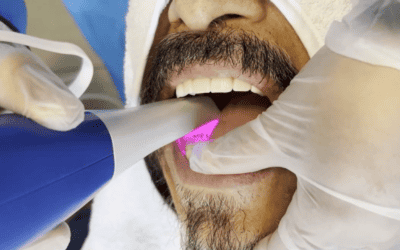
Orthodontics corrects the position of teeth and jaws to achieve a functional and aesthetic smile; however, a short labial or lingual frenulum can interfere with the success of the treatment by limiting movement, causing diastemas, or affecting swallowing and speech (phonation). Laser frenectomy is a minimally invasive procedure that releases this tissue and optimizes orthodontic results.
What is a Frenulum and How Can it Affect Orthodontics?
A frenulum is a band of tissue that connects the upper lip to the gum (labial frenulum) or the tongue to the floor of the mouth (lingual frenulum). When it is too short or poorly inserted, it can:
- Prevent the closure of the gap between upper incisors (diastema).
- Limit tongue movement and affect pronunciation.
- Interfere with the correct placement of braces or movement with aligners.
How Does Laser Frenectomy Improve Orthodontic Treatment?
Laser frenectomy is performed with local anesthesia and precisely cuts the excess tissue, freeing the movement of the lips or tongue. Its benefits in the orthodontic context include:
- Diastema Closure: It eliminates the tension that prevents the approximation of the incisors.
- Improved Occlusion and Function: It facilitates dental movements and masticatory function.
- Greater Long-Term Stability: It reduces the risk of relapse by removing the mechanical cause.
- Rapid healing and minimal visible scar formation.
When is Frenectomy Recommended?
The orthodontist will evaluate the best time—before, during, or after treatment—depending on the case. It is generally indicated before or at the beginning of orthodontics when there is:
- Significant diastema that does not close with orthodontic movement.
- Lingual limitation that affects speech or swallowing.
- Frenulum that prevents proper adaptation of braces or aligners.
For pediatric and breastfeeding cases, consult our guide on laser frenectomy in Guatemala and related articles on iSmile.
Process and Care — What to Expect
- Procedure: Clinical evaluation and, if applicable, local anesthesia; frenulum release with laser and possible indication of rehabilitation exercises if it is a lingual frenulum.
- Recovery: It is usually fast; most people resume normal activities in a few days. Maintain oral hygiene, follow the specialist’s instructions, and attend check-ups.
- Risks and Contraindications: Laser frenectomy is safe, with minimal scarring and a low risk of complications when performed by a qualified professional.
Integration with Other Treatments
Frenectomy is frequently combined with:
- Orthodontics with braces or aligners: Consult our options for orthodontics in Guatemala and the benefits of invisible aligners.
- Smile design and aesthetic restorations when the plan requires multidisciplinary interventions: smile design.
Why Choose Laser Frenectomy at iSmile Guatemala?
At iSmile, we use state-of-the-art laser technology and have a multidisciplinary team that coordinates the frenectomy with the orthodontic plan, ensuring rapid recovery and stable results. Schedule your evaluation at iSmile Guatemala Contact.
Frequently Asked Questions (FAQ)
Is laser frenectomy painful? No. It is performed with local anesthesia, and most patients report minimal discomfort during the procedure.
How long does recovery take? Recovery is fast; most people resume normal activities in a few days. For lingual frenectomies, myofunctional therapy may be recommended to optimize mobility.
Will there be a visible scar? The scar is usually minimal and imperceptible; the laser promotes better healing compared to traditional techniques.
Is frenectomy covered by insurance? Coverage depends on each insurance provider’s plan. We recommend checking with your provider.
At what age can it be performed? It can be performed on children and adults; the ideal time is determined by the specialist based on development and orthodontic planning.