
' d='M0 0h21v15H0z'/%3E%3Cpath d='M0 0h21v1H0V0zm0 2h21v1H0V2zm0 2h21v1H0V4zm0 2h21v1H0V6zm0 2h21v1H0V8zm0 2h21v1H0v-1zm0 2h21v1H0v-1zm0 2h21v1H0v-1z' fill='url(%23b)'/%3E%3Cpath fill='url(%23c)' d='M0 0h9v7H0z'/%3E%3Cpath d='M1.5 2a.5.5 0 110-1 .5.5 0 010 1zm2 0a.5.5 0 110-1 .5.5 0 010 1zm2 0a.5.5 0 110-1 .5.5 0 010 1zm2 0a.5.5 0 110-1 .5.5 0 010 1zm-5 1a.5.5 0 110-1 .5.5 0 010 1zm2 0a.5.5 0 110-1 .5.5 0 010 1zm2 0a.5.5 0 110-1 .5.5 0 010 1zm1 1a.5.5 0 110-1 .5.5 0 010 1zm-2 0a.5.5 0 110-1 .5.5 0 010 1zm-2 0a.5.5 0 110-1 .5.5 0 010 1zm-2 0a.5.5 0 110-1 .5.5 0 010 1zm1 1a.5.5 0 110-1 .5.5 0 010 1zm2 0a.5.5 0 110-1 .5.5 0 010 1zm2 0a.5.5 0 110-1 .5.5 0 010 1zm1 1a.5.5 0 110-1 .5.5 0 010 1zm-2 0a.5.5 0 110-1 .5.5 0 010 1zm-2 0a.5.5 0 110-1 .5.5 0 010 1zm-2 0a.5.5 0 110-1 .5.5 0 010 1z' fill='url(%23a)'/%3E%3C/g%3E%3C/svg%3E)
' d='M0 0h21v15H0z'/%3E%3Cpath fill='url(%23b)' d='M10 0h11v15H10zM0 0h7v15H0z'/%3E%3Cpath fill='url(%23a)' d='M7 0h7v15H7z'/%3E%3Cpath d='M8 7a2.5 2.5 0 001.247 2.164.5.5 0 00.502-.865A1.499 1.499 0 019 7a.5.5 0 00-1 0zm3.846 2.107A2.498 2.498 0 0013 7a.5.5 0 10-1 0 1.5 1.5 0 01-.693 1.265.5.5 0 10.539.842z' fill='%23628A40' fill-rule='nonzero'/%3E%3Ccircle fill='%23DCC26D' cx='10.5' cy='7' r='1'/%3E%3C/g%3E%3C/svg%3E)
What are Wisdom Teeth (Cordales)?
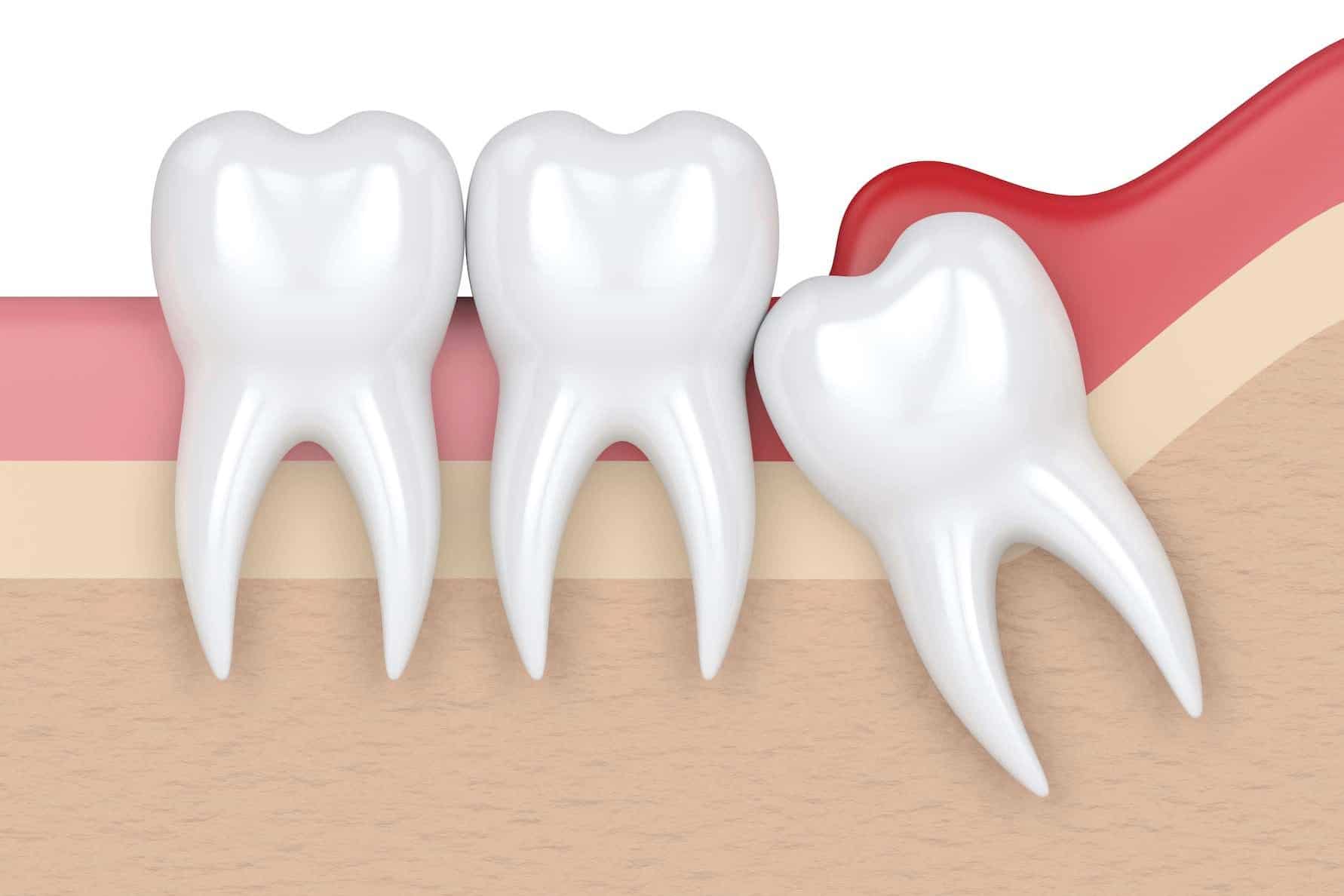
Wisdom teeth (also known as cordales) are the third molars, which typically emerge between ages 16 to 25. They may not appear during this age range or may remain partially embedded in the bone.
These molars get their name because they generally emerge when a person reaches the “age of judgment” or maturity. However, due to human jaw evolution, there often isn’t enough space for them to erupt properly.
When is Wisdom Tooth Extraction Necessary?
It is common to recommend wisdom tooth extraction when they damage or affect other teeth, either by pushing them or erupting crooked or partially. The main reasons include:
Common Problems Requiring Extraction:
Lack of space: When the jaw lacks sufficient space, wisdom teeth can push other teeth, causing crowding that may later require orthodontics with braces.
Impaction: When wisdom teeth become trapped under the gum or partially erupted, creating pockets where bacteria accumulate.
Recurrent infections: Partially erupted wisdom teeth are hard to clean, causing infections, inflammation, and pain.
Cysts or tumors: In rare cases, impacted wisdom teeth can develop cysts that damage bone and adjacent teeth.
Cavities and periodontal disease: Poorly positioned wisdom teeth are hard to clean, increasing cavity risk requiring dental fillings or even root canal treatment.
Damage to adjacent teeth: Wisdom teeth can damage second molar roots, later requiring dental crowns for restoration.
Does Wisdom Tooth Extraction Hurt?
No, anesthesia is always used. If the patient wishes, sedation can be administered. The clinic has a complete team of specialists for the procedure, or it can be done under local anesthesia. These methods ensure wisdom tooth extraction without patient suffering.
Available Anesthesia Options:
Local Anesthesia: The most common option, completely blocks pain in the work area while the patient remains conscious.
Conscious Sedation: Ideal for anxious patients, provides greater relaxation while maintaining patient cooperation.
General Anesthesia: Reserved for complex cases or multiple extractions, performed under anesthesiologist supervision.
Types of Wisdom Tooth Extraction
Simple Extraction
Performed when the wisdom tooth has fully erupted and is visible in the mouth. It is a simpler and faster procedure.
Surgical Extraction
Necessary when the wisdom tooth is impacted or partially erupted. Requires a small gum incision and possibly bone removal.
Extraction Process Step by Step
- Initial Evaluation
A complete clinical exam and X-rays are performed to assess wisdom tooth position and plan the procedure. - Preparation
The chosen anesthesia is applied and the work area is prepared under sterile conditions. - Extraction
The appropriate technique is used based on the case, either simple or surgical. - Postoperative Care
Detailed recovery instructions are provided and follow-up is scheduled.
Care After Extraction
First 24 Hours:
- Bleeding control: Bite on sterile gauze for 30-45 minutes.
- Apply cold: Cold compresses for 15 minutes every hour.
- Avoid rinsing: No vigorous mouthwashes.
- Soft diet: Cold, soft foods.
- Rest: Avoid intense physical activity.
Following Days:
- Oral hygiene: Gentle dental cleaning, avoiding extraction area.
- Medication: Follow painkiller and antibiotic instructions.
- Feeding: Gradually return to normal diet.
- Rinses: Warm salt water after 24 hours.
When to Seek Immediate Medical Attention?
Contact your dentist if you experience:
- Excessive bleeding that doesn’t stop.
- Severe pain not improving with medication.
- Infection signs (fever, excessive swelling, bad taste).
- Prolonged numbness.
- Difficulty swallowing or opening mouth.
Wisdom Tooth Extraction Prices in Guatemala
Cost varies by case complexity:
Factors Influencing Price:
- Complexity: Simple vs. surgical extraction.
- Number of wisdom teeth: Single vs. multiple extraction.
- Anesthesia type: Local vs. sedation.
- Additional studies: Specialized X-rays.
- Postoperative care: Medications and follow-up.
Approximate Price Range:
- Simple extraction: Q300 – Q800 per wisdom tooth.
- Surgical extraction: Q800 – Q1,500 per wisdom tooth.
- Sedation (additional): Q500 – Q1,000.
- X-rays: Q150 – Q300.
Prevention and Early Detection
Warning Signs:
- Pain in back of jaw.
- Gum swelling.
- Difficulty opening mouth.
- Persistent bad breath.
- Unpleasant taste in mouth.
Importance of Regular Check-ups
Regular professional dental cleanings allow detection of wisdom tooth problems before they cause major complications.
Alternatives and Special Considerations
Is Wisdom Tooth Extraction Always Necessary?
Not always. If there’s sufficient space, good positioning, functionality, and they can be kept clean, they can be preserved. Your dentist will evaluate each case individually.
Considerations for Children and Adolescents
Early monitoring is important. Orthodontics in children can often be affected by wisdom tooth eruption.
Advanced Technology at iSmile Guatemala
At iSmile Guatemala we use:
- 3D digital X-rays for better planning.
- Minimally invasive techniques to reduce discomfort.
- Laser technology for faster healing.
- Intraoral scanner for precise diagnosis.
Wisdom Tooth Extraction and Other Treatments
Treatments That May Require Prior Extraction:
- Orthodontics with braces: To create necessary space.
- Smile design: For optimal aesthetics.
- Dental implants: In cases of damage to adjacent molars.
Your Specialist Team at iSmile Guatemala
We have oral and maxillofacial surgeons specialized in wisdom tooth extraction, backed by anesthesiologists and specialized nursing staff. Our approach prioritizes maximum comfort and safety throughout the process.
For cases requiring comprehensive care, you can also consult our complete oral rehabilitation services.
Don’t wait for pain to stop you! Schedule your evaluation at iSmile today and discover if you need wisdom tooth extraction. Our specialist team will provide the best care with cutting-edge technology.